Why I Am the Buddhist Biohacker
Ancient Wisdom, Modern Science, and the Evolving Mirror of Consciousness
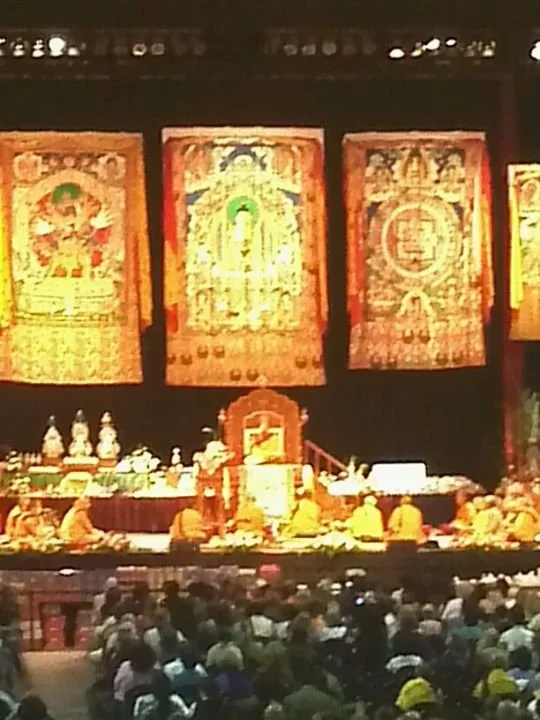
Long before I ever used the phrase Buddhist Biohacker, I found myself sitting in a crowded auditorium in Radio City Music Hall, New York, waiting for His Holiness the Dalai Lama to enter the room.
The atmosphere was unlike anything I had experienced before. Hundreds of people sat quietly, monks in crimson robes mingling with students, volunteers, and seekers who had traveled from around the world. When the Dalai Lama walked onto the stage, the energy in the room seemed to shift immediately. His presence carried something rare—a combination of intellectual brilliance and deep warmth, a mind devoted to inquiry and a heart devoted to compassion.
Over the years I would encounter him several times: through public teachings, through the Kalachakra initiations, and through the privilege of volunteering during his visits to the United States. In one smaller gathering he spoke to a group of Tibetan community members and volunteers about the importance of education.
If we wish to understand reality, he explained, we must study the science of the mind.
Without understanding how thoughts arise, how emotions shape perception, and how attention interacts with the world we experience, it becomes difficult to see clearly. Spiritual practice, he reminded us, is not meant to replace knowledge.
It is meant to deepen it.
Those words stayed with me.
They planted a seed that would eventually grow through my studies of Tibetan Buddhism, functional medicine, genetics, contemplative psychology, and eventually the emerging technologies that allow us to explore consciousness in entirely new ways.
At the time, I did not yet realize that these paths would converge into something I now call the Buddhist Biohacker.
The Living Lineage
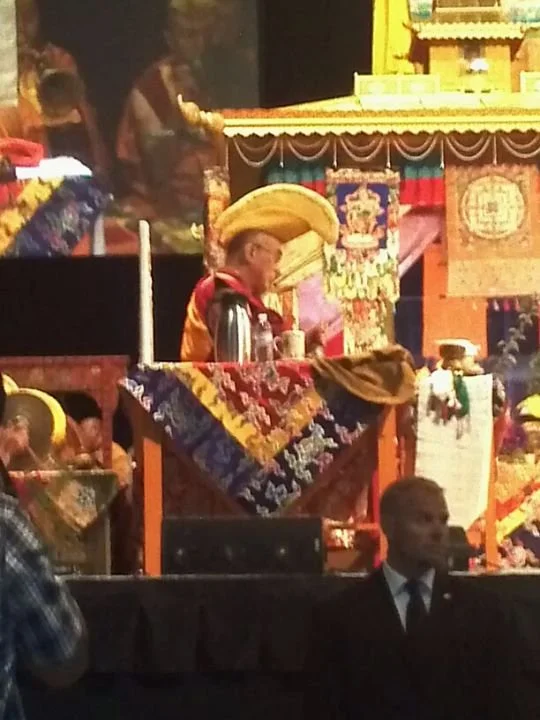
My relationship with Tibetan Buddhism has never been purely intellectual. It has unfolded through direct encounters with teachers and through initiations received within the lineage itself.
Over the years I have had the profound privilege of receiving Refuge Vows, the Bodhisattva Vow, the Kalachakra Initiation, and teachings connected to Yamantaka practice from His Holiness the 14th Dalai Lama.
In Tibetan Buddhism these transmissions are not simply ceremonial events. They represent moments of alignment with a lineage of wisdom that stretches back centuries.
Taking Refuge signifies a commitment to awakening—to orient one’s life toward wisdom, compassion, and the liberation of suffering.
The Bodhisattva Vow deepens that commitment. It is the promise to pursue awakening not only for oneself but for the benefit of all beings. In this view, personal transformation is inseparable from collective well-being.
The Kalachakra Initiation, often described as one of the most expansive empowerments in Tibetan Buddhism, introduces a vast mandala of understanding in which the cycles of the cosmos, the rhythms of the body, and the movements of consciousness mirror one another. Kalachakra literally means “Wheel of Time,” and its teachings reveal how inner transformation and the unfolding of the universe reflect the same underlying intelligence.
The teachings associated with Yamantaka, a fierce manifestation of Manjushri, confront practitioners with another dimension of transformation: the courage to face fear, death, and the shadow aspects of the psyche as gateways to wisdom.
These initiations are not trophies to collect.
They are seeds planted in the soil of consciousness.
Their meaning unfolds slowly over years of study, reflection, and lived experience.
The Moment the Worlds Collided
Years later, during a teaching in the fall of 2025 with Tenzin Wangyal Rinpoche, something happened that crystallized my understanding of the path I had been walking.
Rinpoche—often called the “dream, sleep, and dreaming lama”—is known for bringing the ancient practices of Tibetan Dream Yoga into modern consciousness studies. His book The Tibetan Yogas of Dream and Sleep has guided practitioners around the world in exploring awareness within the dream state.
During this teaching he shared a story from rural Tibet.
There once lived a man in a mountain village whose job was to carry luggage from Sherpas into the town. For generations this had been how goods traveled through the mountains.
Eventually the village began discussing the possibility of building a road.
The man was upset. If trucks could drive directly into the village, his job would disappear. The life he had always known would vanish.
What he could not yet see, Rinpoche explained, was that the road would not simply replace his work.
It would transform the entire village.
Trade would expand. Travel would become easier. New opportunities would appear—opportunities that could not exist until the road was built.
The road was not the end of the old world.
It was the beginning of a new one.
Then Rinpoche made a comment that surprised many people in the room.
With a gentle smile he said that if he had a philosophical question, he might ask artificial intelligence rather than another lama—because AI could gather teachings from countless masters across centuries.
Some people laughed.
Others looked uncertain.
But for me, the statement landed with clarity.
It echoed something I had been sensing for years: technology is creating new mirrors through which consciousness can observe itself.
Later in the same teaching Rinpoche mentioned something equally surprising.
He tracks his sleep using a Garmin watch.
Our emotional mind, he explained, often tells us stories about what we need or do not need. The pain body can distort perception. But biological measurements—heart-rate variability, sleep cycles, and recovery data—reveal what is actually happening inside the body.
Science becomes a tool for honesty.
In that moment the two worlds I had been living in—Buddhist contemplation and scientific investigation—suddenly aligned.
The Dalai Lama and the Spirit of Inquiry
This alignment is not accidental.
For decades the Dalai Lama has engaged in dialogue with neuroscientists, psychologists, and physicists through the Mind and Life Institute, exploring how meditation influences the brain and how compassion can be cultivated through contemplative practice.
Perhaps even more remarkable is his willingness to challenge his own tradition.
He has famously said that if scientific evidence contradicts a particular Buddhist claim, Buddhism must change.
Truth must always take precedence over tradition.
In this sense Buddhism is not simply a religion.
It is a science of mind.
Meditation is an experiment conducted within the laboratory of awareness.
As the great Indian master Padmasambhava once said:
“Though my view is as vast as the sky, my actions and respect for cause and effect are as fine as grains of flour.”
The contemplative path invites both vast awareness and careful investigation.
My Own Laboratory

My exploration of what people now call biohacking began not through philosophy but through necessity.
Like many people who enter the world of functional medicine, my journey began with personal health challenges. I faced issues related to parasites, environmental toxicity, and genetic mutations such as MTHFR, which influence how the body detoxifies and processes nutrients.
Healing required curiosity.
I began studying genetics, epigenetics, metabolic pathways, nutrition, and the intricate biochemical systems shaping human health.
The more I studied these systems, the more I noticed something remarkable.
The investigative spirit of biohacking felt strikingly similar to the investigative spirit of Buddhist meditation.
Both seek to reveal patterns hidden beneath ordinary awareness.
One examines the architecture of the body.
The other examines the architecture of the mind.
Together they illuminate a much larger picture of human experience.
Mirror-Like Wisdom
In Tibetan Buddhism there is a concept known as mirror-like wisdom.
One of the five expressions of enlightened awareness, mirror-like wisdom describes the mind’s ability to reflect reality clearly without distortion. Just as a mirror reflects whatever appears before it without clinging or rejection, awakened awareness observes thoughts, emotions, and experiences without becoming trapped within them.
The Dzogchen teachings often describe this state beautifully:
“The nature of mind is like a mirror—empty yet capable of reflecting all appearances.”
This metaphor of the mirror appears throughout contemplative traditions.
It also appears, interestingly, in the modern technologies that help us understand ourselves.
Meditation reveals the movements of the mind.
Wearable devices reveal the rhythms of the body.
Functional medicine reveals biochemical patterns influencing mood and health.
Artificial intelligence can reveal patterns in language, memory, and narrative.
Each of these tools becomes a mirror.
And the purpose of a mirror has always been the same.
It allows us to see.
The Three Laboratories of the Buddhist Biohacker
As my work evolved, I began to see that the exploration of consciousness was unfolding through three complementary arenas of inquiry.
I began thinking of them as the three laboratories of the Buddhist Biohacker.
The Laboratory of the Body
The first laboratory is the body itself.
Through nutrition, functional medicine, genetic testing, sleep tracking, and physiological measurement, we gain insight into the biological systems shaping our energy, emotions, and cognition.
Biohacking, at its best, is simply curiosity about how the body actually works.
The Laboratory of the Mind
The second laboratory is the mind.
Meditation, dream yoga, contemplative philosophy, and psychological inquiry reveal the patterns through which awareness interprets experience.
For thousands of years contemplative traditions have explored attention, perception, and consciousness through direct observation.
The Laboratory of Reflection
The third laboratory is reflection.
Writing, dialogue, psychological analysis, and modern tools such as artificial intelligence allow us to examine the narratives shaping our lives.
Through reflection we begin to see patterns in relationships, beliefs, and emotional responses that might otherwise remain invisible.
Together these three laboratories form a powerful system of self-understanding.
The body reveals physiology.
The mind reveals awareness.
Reflection reveals the patterns connecting them.
Walking the Road Between Worlds
The Buddhist Biohacker stands at the intersection of two great traditions of inquiry.
One is ancient, rooted in meditation halls and philosophical teachings exploring the depths of consciousness.
The other is modern, emerging from laboratories, medical research, and technological innovation.
Both traditions share the same question:
What does it mean to be human?
The Tibetan teachers I studied with never treated science as the enemy of spirituality. On the contrary, they welcomed it as another way of illuminating reality.
Today we are living at a moment when these two streams of knowledge can finally speak to one another.
Meditation cushions and microchips are no longer strangers.
They are partners in the same exploration.
The Work Ahead
When I reflect on the phrase Buddhist Biohacker, I realize it is less an identity than an invitation.
An invitation to approach life with curiosity.
To recognize that the body and the mind are not separate systems but intertwined expressions of consciousness.
To use every available tool—ancient teachings, modern science, reflective dialogue, and emerging technologies—to understand the patterns shaping our experience.
Ultimately the goal is not optimization.
It is awakening.
Not the awakening of some distant spiritual ideal, but the simple recognition that the awareness observing our thoughts, emotions, and experiences has always been present.
All the mirrors—meditation, science, technology, and reflection—are simply helping us see it.
And in that recognition, the experiment of consciousness continues.